
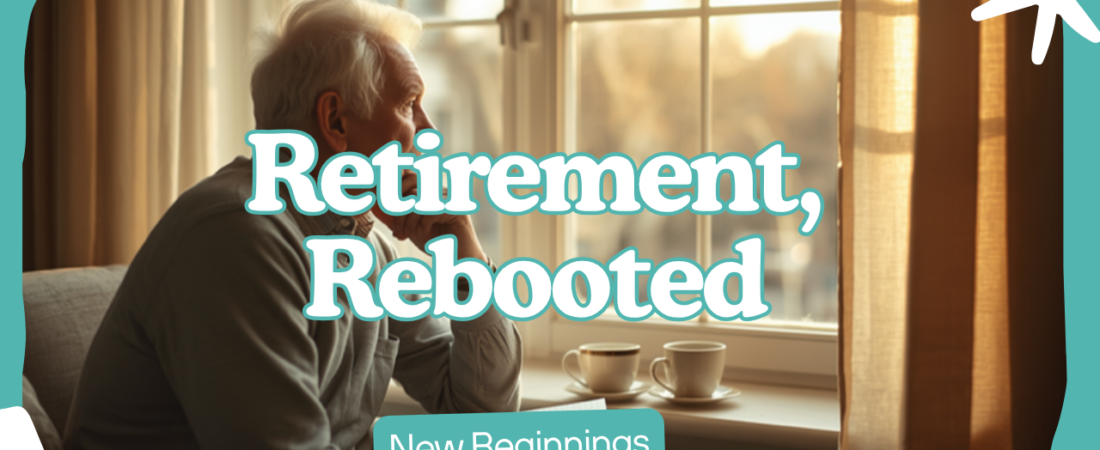
…somewhere around the eighteen-month mark, usually. That’s when I hear it most, in one phrasing or another: “I don’t understand it. I have everything I planned for, and I’m restless anyway.”
I want to spend this piece defending an unfashionable idea: that boredom, not loneliness, is the retirement risk we talk about the least and prepare for the worst.
Loneliness gets all the attention, and reasonably so — it’s real, it’s measurable, and it deserves every article written about it. But I think we’ve let it eclipse a second, quieter danger that doesn’t look serious enough to warn anyone about, because “bored” sounds like such a small word for something that can genuinely hollow out a few years of a life. Boredom doesn’t photograph well. Nobody writes a worried article titled “The Empty Tuesday Afternoon Epidemic.” It just sits there, low and flat, while people assume something’s wrong with them for feeling it, since surely — surely — a life with no obligations left in it should feel like relief and nothing else.
Here’s the case for taking it seriously.
Gerontologists who study the transition out of work describe something called role loss — not the loss of income or routine specifically, but the loss of anywhere your effort is required by someone else. For decades, most of us occupy roles that make daily demands: an employee, a manager, the parent whose sandwich-cutting skills were, at one point, load-bearing infrastructure for an entire household. Those roles are exhausting, and people spend years looking forward to shedding them. But they also generate something people rarely credit them for: unavoidable proof, delivered daily, that your effort matters to someone. Retire the role, and you don’t just lose the demands. You lose the proof.
This is why boredom and loneliness, while related, aren’t the same disorder with two names. You can have a full social calendar — a spouse, a standing coffee with old colleagues, grandchildren on a screen every Sunday — and still be quietly starved for something structured to reach for that isn’t optional. Loneliness is a shortage of people. Boredom is a shortage of purpose. Fixing one doesn’t automatically fix the other, which is exactly why so many well-connected, well-loved retirees still report feeling restless in a way that puzzles everyone around them, themselves included.
Watch what actually happens across a typical retirement, and the shape of the problem gets clearer. Year one tends to be busy on its own momentum — the trip that got postponed for decades, the garden finally redone properly, the list of projects that accumulated for years under the heading “when I have time.” That list has an end, though, and somewhere around year two or three, most people finish it. The calendar that felt luxuriously open in month one starts to feel, by month eighteen, less like freedom and more like an absence with no edges. Nobody warned them boredom was a distinct problem, separate from missing their coworkers, so they don’t recognize it when it arrives. They just feel a vague, embarrassing restlessness they assume reflects badly on their own gratitude, which makes it worse, because now there’s shame stacked on top of the boredom.
If this is where the last year or two has quietly landed you, here’s the reframe I’d offer first, before any advice: the restlessness is not ingratitude for a life you worked hard to earn. It’s information. Bodies and minds that spent forty or fifty years being needed daily don’t stop needing that just because the paycheck did. Treat the feeling as a signal worth investigating, not a character flaw worth hiding.
As for what actually helps — and I’ve changed how I answer this over the years — I no longer recommend hobbies as the main prescription, and I want to explain why, because it’s a real distinction and not just semantics. A hobby fills an hour pleasantly and can go on filling hours indefinitely without ever resolving into anything. What seems to do more of the real work is something closer to a project: an undertaking with a beginning, a middle, an actual end, and — this part matters — a result someone besides you will notice or benefit from. Restoring one piece of furniture at a time, rather than “getting into woodworking” in the abstract. Learning conversational Spanish for a specific trip six months out, rather than “learning a language” with no deadline attached. Running the neighborhood’s spring plant sale, rather than “gardening” as a general pastime. The difference isn’t effort or skill. It’s shape. A hobby can drift pleasantly forever. A project has an arc, and an arc is precisely what a calendar full of open, undifferentiated afternoons is missing.
The other piece of advice I’d add, and it’s less about activity than about honesty: say it out loud. Most people treat post-retirement restlessness as something to manage privately, maybe by quietly picking up a new pastime and hoping it takes. I’d rather you mention it directly to the people around you, the way you’d mention any other nagging discomfort. “I think I’m going a little stir-crazy” is a sentence that recruits help, ideas, company, accountability. Sitting on it quietly just produces more identical afternoons, indefinitely, with nobody around you aware there’s even a problem to solve together.
If the quiet in your calendar has started to feel less like peace and more like an absence you can’t quite name, trust that. It isn’t a flaw in how you’re doing retirement. It’s a perfectly ordinary transition problem that happens to be under-discussed, which is different from being rare. Pick one unfinished thing with a real endpoint. Tell somebody you’re starting it. Give it a date, even an arbitrary one, even if nobody’s checking.
Eighteen months in is exactly when this tends to surface. If that’s roughly where you are, you’re not behind schedule. You’re right on time to notice it — and right on time to do something about it.
— Eleanor