
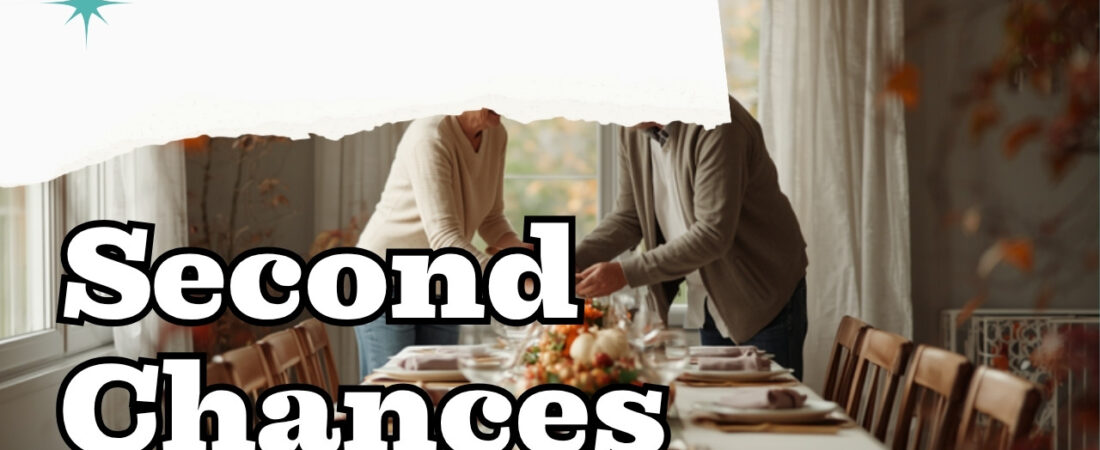
The seating chart. Nobody warns you that the war will be fought over a seating chart.
Not the wedding itself — weddings at our age are lovely, brief, sensible affairs; nobody’s renting a castle. No, it’s afterward, at the first Thanksgiving, when somebody has to decide where the new husband sits. Because there’s a chair at that table that belonged to someone. Everyone knows which chair. And a sixty-eight-year-old bride can watch her own children — grown adults with mortgages and gray hair of their own — go quietly rigid over the placement of a placecard.
If you’ve remarried late in life, or you’re headed there, and you’re bewildered that your children — adults! — are behaving like this, I want to walk through what’s actually happening at that table. Because it’s both more understandable and more fixable than it feels at two a.m.
Start here: your children’s resistance is almost never about your happiness. When pressed — really pressed — most adult children will say, and mean it, that they want their mother happy. The trouble lives one layer down, where three quieter fears sit tangled together.
The first fear is about the story. A late marriage rewrites the family’s book — or feels like it does. If Mom is this happy with someone new, what does that say about the forty years with Dad? Your children are guarding your late husband’s chapter, worried it’s being torn out. They can’t say this, because said aloud it sounds absurd — you were there for the whole marriage, after all; its reality doesn’t need their protection. But grief math is not public math. To them, every photograph the new husband appears in can feel like one their father was cropped from.
The second fear is about place. Family scholars who study remarriage — it’s a well-studied field, stepfamilies now being roughly a third of American families — keep finding the same thing: adult children experience a parent’s remarriage as a reshuffling, and nobody handed them their new card. Is this man now the host of Christmas? Does his daughter come? Whose name goes on the emergency form, and who gets called first? Silly questions, until they’re not.
And the third fear — let’s not pretend otherwise — is about money and the house. The house their childhood lives in. The inheritance no decent child will admit to thinking about, and nearly every child quietly thinks about. Not from greed, mostly; from symbolism. Assets late in life are how families keep score of belonging, which is exactly why this fear responds so well to plain talk and so badly to silence.
Three fears: the story, the place, the stakes. Now — what actually helps, from couples who’ve navigated this well.
Say the sentence about the past, out loud, early, and mean it: “He isn’t a replacement. Nobody is being replaced. Your father’s chapter doesn’t shrink because the book turned out to be longer.” Your children need to hear that you know it — not deduce it, hear it. And the new husband, if he’s wise (and if he’s marrying you at this age, he’d better be), signals the same thing in actions: he doesn’t sit in the chair. Not the first year. He asks where he should sit. There is no faster way for a newcomer to earn a family’s trust than visibly declining to claim what isn’t his.
Then handle the paperwork like grown-ups, unprompted. A conversation — brief, dry, unromantic — in which the children learn that the wills are updated, the house is settled, and nobody’s inheritance is a mystery. I know couples who dreaded this talk for a year; it tends to take twenty minutes and lower the family temperature ten degrees. Most of what looks like coldness toward a new spouse is actually unasked questions curdling.
Give it time in units of years, not dinners. The stepfamily researchers are blunt on this: blended families take years to knit, and later-life blends are knitting people who are fully formed, busy, and not living under one roof. The new husband will not be beloved by spring. Fine. He doesn’t need to be beloved by spring; he needs to be known — which happens in small, repeated, unforced doses. The fishing trip nobody organized as A Bonding Event. The lift to the airport. The slow discovery that he’s the one who fixed the gate that had been broken for two years.
And hold one line, kindly, from the start: the children get a vote on many things, but not on this. Their concerns get heard — truly heard, not managed. Their loyalty to their father gets honored. But the decision was never on the ballot. You are not asking permission to be loved at sixty-eight, and the children — this is the strange mercy of it — are usually relieved once that’s clear. Children, even gray-haired ones, rest easier when a parent is steady at the wheel.
Will it all resolve? Honestly: mostly, and not entirely, and on no schedule you control. Some knots loosen at the first grandchild’s birthday he attends. Some at a hospital bedside years on, when the children discover what it means that someone is there, at your side, at two in the morning, so they didn’t have to be afraid from three time zones away. And one or two knots may simply stay tied, and you’ll live around them, the way every family lives around something.
But I’ll tell you how you’ll know it’s turning. It won’t be an announcement. It’ll be a Thursday. Somebody’s car trouble, somebody needs a ride or a ladder or a signature witnessed — and the phone that rings will be his.
Nobody will mention the chair again after that. Someone will just set an extra place, wherever there’s room.
Which is, come to think of it, all a family ever was.