
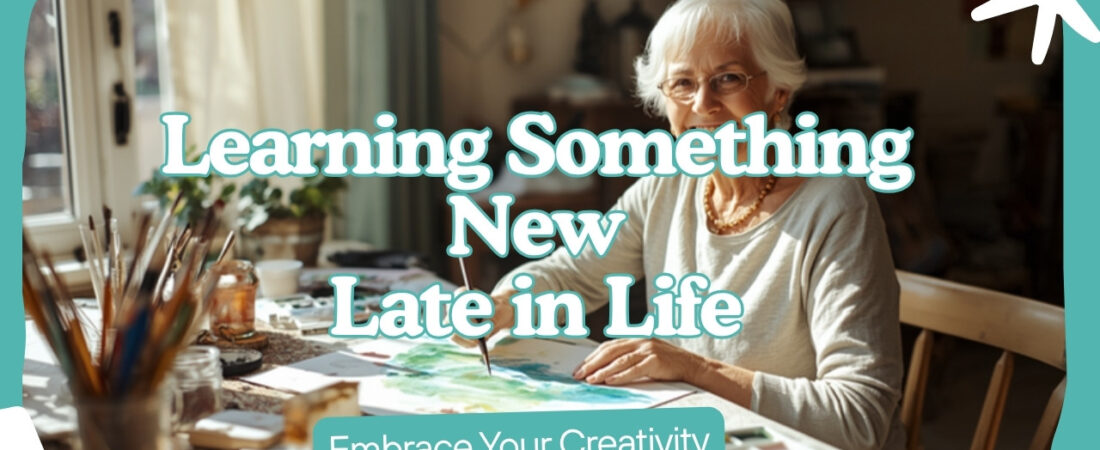
I have been learning to paint with watercolors for two years now, and I want to report my progress honestly: I am terrible.
Not “modest-beginner” terrible. Terrible with tenure. My clouds look like upset sheep. My one attempt at a portrait of my grandson produced something my daughter — carefully, over the phone — called “very brave.” I have produced, by conservative count, ninety paintings, of which perhaps four could be shown to a stranger, provided the stranger were kind and the lighting poor.
I also haven’t loved a Tuesday afternoon this much in twenty years. And I’ve come to believe the two facts are connected — that the terribleness isn’t the price of the joy. It’s closer to the source of it. Let me make the case, because somewhere out there you’ve been circling something — a language, a piano, bread, chess, tango, Italian — for years, and talking yourself out of it with arithmetic about your age. I’d like to retire that arithmetic.
Start with what the scientists would tell you, because it’s cheerier than the culture is. The brain does not, as we were all taught, finish growing and then spend fifty years quietly going downhill. It remains plastic — rewirable by new demands — into the ninth decade. Studies of older adults who take up genuinely new skills (not puzzles that rehearse old ones — actually new things, photography, tablet use, quilting) find measurable gains in memory that persist after the classes end. The demanding-ness is the active ingredient. The struggle you’re dreading — that fumbling, effortful, where-do-my-fingers-go stage — is not the obstacle to the benefit. It is the benefit. Nothing wakes an experienced brain up like being confused again.
But the science isn’t really why I paint. Let me get at the real reason through a thing that happened at my kitchen table.
My grandson, then six, was drawing with me. He finished a horse — a magnificent, anatomically impossible horse — held it up for one second of pure satisfaction, dropped it on the floor, and started the next one. No review. No verdict. The horse was already behind him; the joy was in the making, and the making was over, so: next horse.
Somewhere between his age and ours, that gets taken from us. We learn that output gets graded. Decades of being competent — of being the one who knew how, at work, at home, in the kitchen — quietly convert every activity into a performance with stakes. And that’s the actual reason we stop learning new things as we age. It was never the brain. It’s that we cannot bear to be bad at things anymore, and everything new begins with being bad at it.
Which is exactly why the new thing at seventy is not a luxury. It’s a repair.
Because here’s what those first terrible months actually give you, and I say this as a certified producer of upset-sheep clouds: a place in your week where nothing is riding on you. No one needs the painting. The painting has no deadline, no audience, no invoice. Every other corner of adult life kept score for fifty years, and this one doesn’t — unless you bring the scorekeeper along. Leave her at the door. She’s tired anyway.
There’s a lovely idea in the research on wellbeing — flow, the psychologists call it: the state where a task absorbs you so completely that time goes strange and the self, with all its anxieties and its aches, goes quiet. Two hours pass like twenty minutes. Here’s the detail everyone misses: flow doesn’t require being good at the task. It requires the task to be just barely too hard for you. Which means the beginner — permanently, gloriously in over her head — has better access to it than the expert does. At seventy, being in over your head is not the deep end. It’s the spa.
And one more gift, the social one: a classroom is the last place in the world where nobody cares who you used to be. The retired judge and the retired school-lunch lady are equals before a lump of pottery clay, united in producing equally alarming ashtrays. Every friendship I’ve made this decade started in some version of that room. Shared incompetence, it turns out, bonds faster than shared success ever did — there’s no résumé to compare, only the sheep-clouds, and everybody’s sheep-clouds are hilarious.
So, practical notes from the field, briefly. Pick the thing you circled just now while reading — you did; I heard it from here. Sign up for the actual class, with other humans in it, rather than the app alone at midnight — the humans are half the medicine. Pay for eight weeks up front; motivation follows money. Tell exactly one encouraging person. And prepare — this is the only hard part — to be six years old again for a few months: fumbling, frustrated, occasionally magnificent by accident.
Then keep the first thing you make. However it turns out. Especially if it’s dreadful. Date it, put it in a drawer, and look at it in a year, when you’re merely bad instead of terrible — because measurable progress at seventy is champagne, and nobody warns you.
My first painting is in the kitchen drawer with the batteries and the twine. It’s of my old house — you’d need to be told that, and possibly shown the house — and the sky above it looks, my grandson assures me, “like the sheep are angry.”
It’s the best worst thing I own. Come make one. The water’s terrible.